


Demographics in senior living are changing. Sometimes a blanket statement we know to be true but what does it mean across the entire sector, for operators and for ownership groups?
The data below brings clarity and understanding to a diverse, dynamic and evolving customer. Grouping an age span of 62 to 98+ into a single demographic is the first pitfall of community, group-based programming and calendar offerings.
For engagement professionals trying their hardest to be all things to all people, still feeling like you are coming up short and not meeting expectations of your executives, this is why.
You Are Not Crazy
This is also true for Sales Leaders navigating nuances to go from lead to conversion, Care staff that have to morph themselves to meet resident expectations, Culinary teams that are continuously trying to deliver on dietary preferences, Executive Directors doing their best to keep families and residents informed. For new development and reinvested capital, this also throws us a curve ball. Now, and next is the name of the game. Keeping your promise to customers on what was sold while also changing product and supply to bring in new customers is a hairy road. I refer to this as a necessary, and preparatory disruption. You cannot sell what you have not yet mastered. We are all in a learning phase. Embrace it!
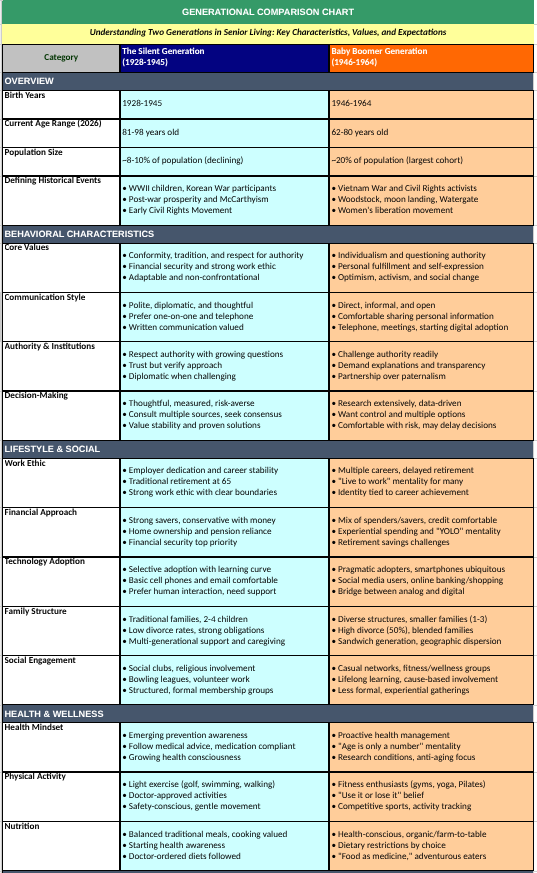
Generational Comparisons
Not everyone fits into their generational category; however these are traits that we know to be true about two different customers. If you have worked in a community, you feel this everyday. Values, interests, behaviors, trust, autonomy, preference; they are all over the place. Markets and locations within the US also add a layer of complexity for national portfolios. While standards and guidelines are necessary, I cannot help but believe the quest for standards is not as straightforward as we would prefer. To tout that we are meeting all the individual lifestyle needs and desires of our customers is a bold statement. We are trying, but have room for improvement and understanding what that statement means to the customer.
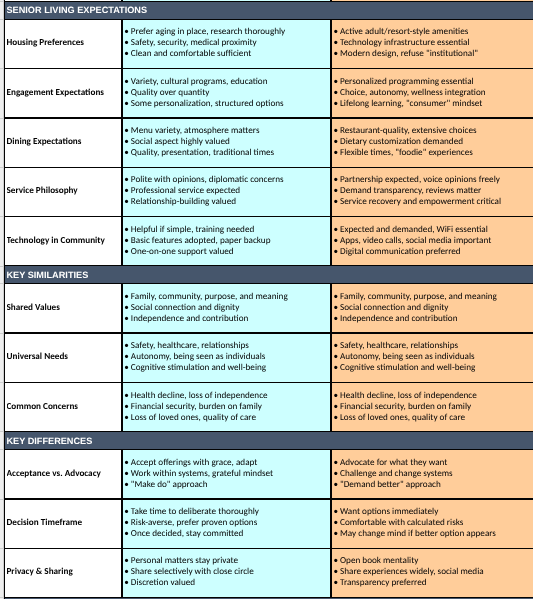
Expectations, Similarities and Difference
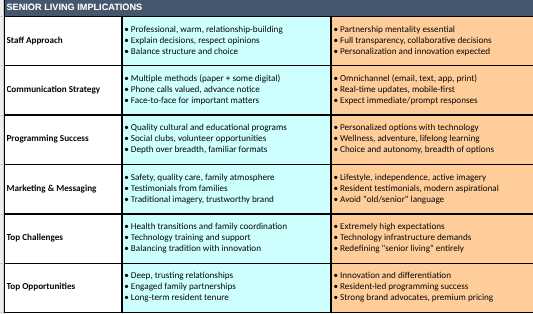
What Does This Mean for Senior Living Operations?
Balance is key. Transparency is critical. Explanation is necessary. Reasonable expectations must be communicated. The product is not changing as quickly as the consumer is. Levels of care are not just a clinical distinction. A different wing, floor, dining room or engagement space. Customer service training cannot be overlooked. The workforce needs assistance and guidance on how to adapt to consumer demands without getting frustrated or being misplaced in an area where their skillset, personality and approach does not align with the customer base. Strategic staffing, lateral moves, transfers and listening to staff feedback is more important than ever if we want to create an environment of service, joy and success in the workplace.
Breaking it Down
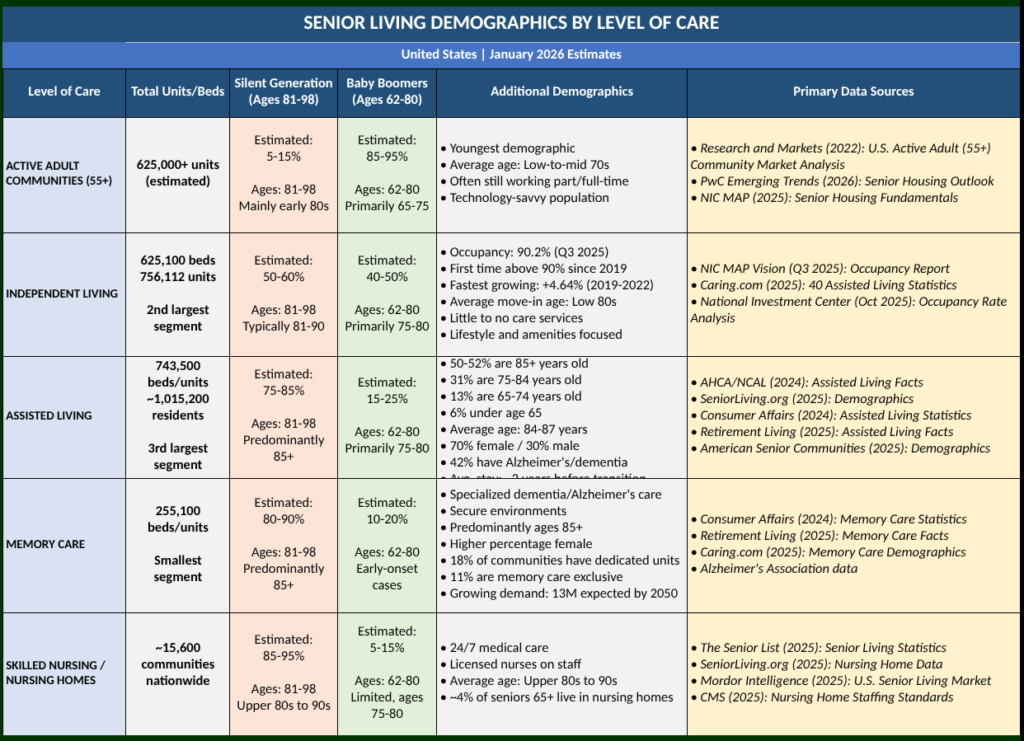
Will consumers change the industry quicker than we can transform it internally? Instead of thinking we have it covered; listening, observing and humility to admit what we have not ever encountered sounds like a better path to evolution. Each level of care is a different persona and customer based on occupancy and census metrics. What we know about a younger demographic moving in is not as widespread as the brush we wield.
*Active Adult has the cleanest break when it comes to customer homogeneity. Despite the homogenous data, we know the Active Adult customer is not one size fits all. Not everyone is focused on health and wellness or an active lifestyle.
* Independent Living is the unknown. An almost 50/50 split of inhabitants. This is where the wheels fall off in programming. Why division occurs among peers. Why the offering is referred to as “too easy or too hard.” Why individualized programming feels impossible for a team of 1,2 or 3 people to master. Why technology adoption stalls. Why people disengage. To be successful in the current climate of independent living programming you have to find a way to customize offerings and stop planning for one group of participants. Not everyone is going to like everything. And. That. Is. Okay! If I had magic wand to wave, I would create two separate programming approaches. I would have two different directors overseeing each program approach instead of assistants following the lead of one master calendar. This may be temporary, but it is paramount while we are straddling the fence of two cohorts.
* Assisted Living is predominantly a Silent Generation product. With the length of stay averaging 22-28 months does this start to skew towards Boomers in that magical year of 2030, or does it continue to garner a customer base that is living longer, keeping the average age static?
How to Navigate
Before you make major investments in programming, fitness, technology and design, look at the demographics. What works for one level of care may not be suitable, needed or of interest to another. Independent Living and Assisted Living are different worlds in the current landscape. In the interim, flexible spaces that can house multiple offerings and attract various interests should be thoughtfully considered for long-term use.
Extend a Bit of Grace
My heart hurts when engagement professionals are labeled “boring, not energetic enough, not creative enough, unable to attract X number of people, told they are ruining tours because there is no life at said hour of the day.” This role has become increasingly more difficult over the past few years. The tools, education and time spent supporting lifestyle directors are still in deficit. If you do not do anything else with this data dump, please extend a bit of grace, help problem solve, suggest solutions and do not place blame of a less than stellar environment on the shoulders of one person or one department. I promise you, they cannot be successful flying solo.
If you have a secret I would suggest sharing. As in industry we ride together. What hurts one, hurts all. What lifts one abolishes stereotypes across the entire sector.
Let’s play nice,
Sara